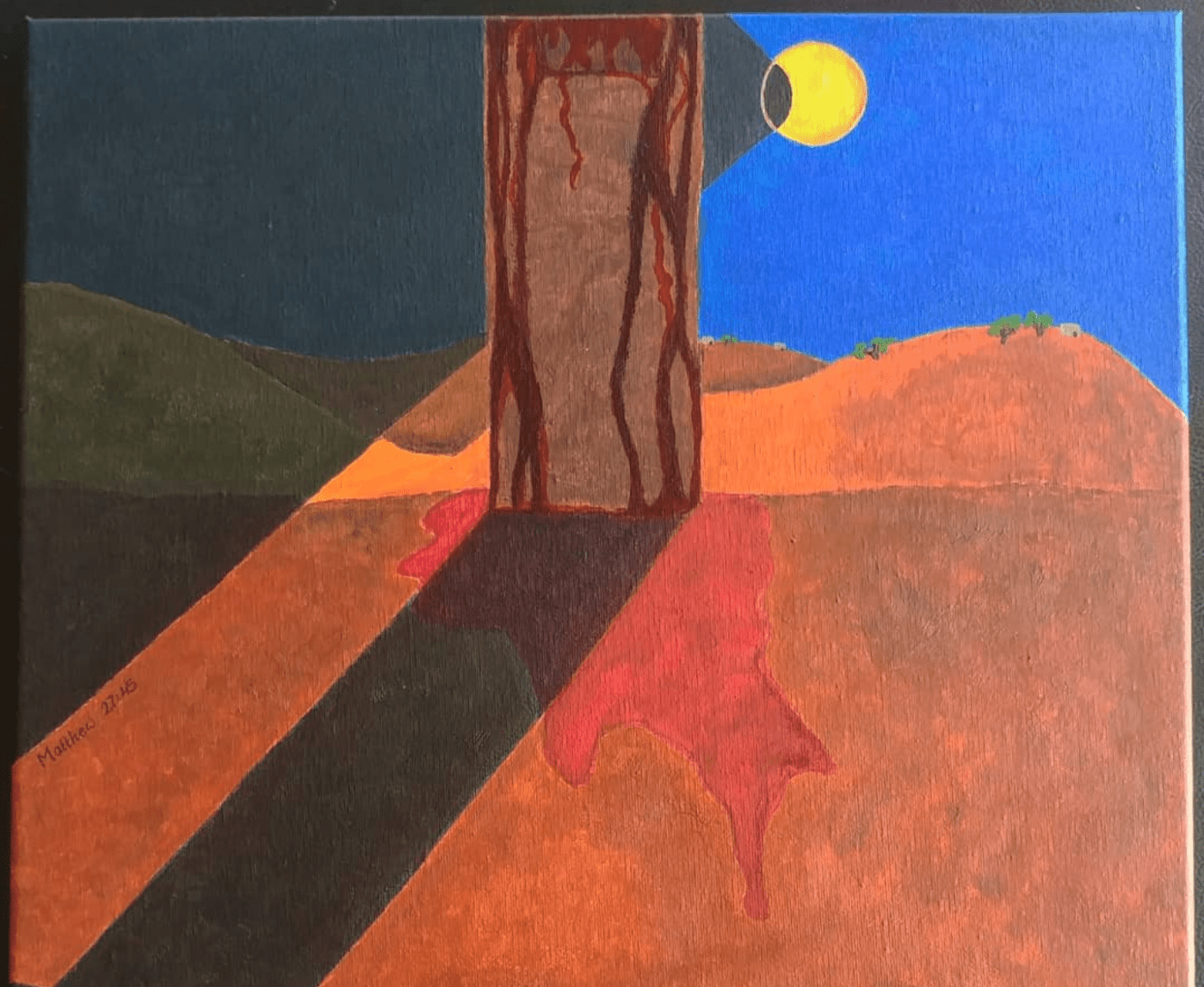
Usually Easter time is a time of great reflection and spiritual zeal for me. This year, on Maundy Thursday of all days, I feel distant and unmoved. To me, this is no small thing. As someone who feels with passion my connection with God, not feeling is cause for disquiet. On a whim, this is how I wrote of it to friends:
“When I’m in (class, studying the book of) Isaiah, like I love seeing God at work and understanding His word and thinking about Jesus and how He fulfils the scriptures, and it stirs my spirit and it’s beautiful. But in a weirdly detached kind of way. And then I leave class, and prayer feels like a desert, and bible reading feels like water running through cupped hands, and spiritual discipline feels like eating dry wall.”
I learned earlier this year that one of my past lecturers had asked someone whether I was still a Christian. It wasn’t asked in judgement, but care, and probably due to any number of reasons. Not least, I believe, because so many friends I had made in my very first year of studying Christian theology are no longer actively walking with Christ.
As much as I have been, and still am, a proponent for as many Christians as possible completing at least some theological study, the truth is that it is not a safe path to walk, and is not for the unprepared or weak of heart. In Australia, we cringe when talking about the devil – but the Bible warns us of the enemy who is opposed to God’s will; and I do believe that when God’s people undertake to know Him and His word more fully, all that is opposed to the things of God – the devil, and our own sinfulness – rear their heads to strike out against such undertakings. There are many passionate Christians who do not realise this, and enter into theological studies in this ignorance, and fall into snares of confusion, bitterness, and spiritual hurt in their course. I would have been one of them, except for God’s grace in pushing people in my way to warn, remind, encourage, and care for me throughout my studies.
Even still, I am not immune to the stumbling blocks that theological studies can present.
I do not recommend anyone, let alone someone with ADHD, study both Isaiah and Church History at the same time. It’s rough. Not only am I angry and hurt that God would make his word so apparently inaccessible and confusing to people such as me (the book of Isaiah is not my friend right now); I am also once more dealing with the dichotomy of voices that tend to appear whenever I attempt to continue my studies. There are people who tell me that because of how ADHD impacts the speed with which I can read and organise information, I am not suitable for theological education; pitted against people urging me to persist. Yet, more injury than either of these comes from delving, once more, into Church history – a minefield of Christian disagreements, moral downfalls, physical and spiritual violence, and theological differences. Scattered across this minefield are invaluable gems of beauty, knowledge, wisdom, sacrifice, and Christian love. Yet it is impossible to traverse it without noticing the blood and bodies strewn across the path.
“How can we really know who you are, or how we are to relate to you, or even how to read your word, when there has been so much blood spilled and lines drawn? When so many righteous and faithful men and women have disagreed so vehemently? How are we supposed to determine which ideas are right, when those who spent their entire lives saturated in the study of the word, come to different conclusions? Is your grace really enough? Or is that itself just another idea, which might or might not be true?”
These are some of the questions I have asked God, in the desert of my prayer life, feeling even the words themselves evaporate in the spiritual dryness; followed by questions that, funnily enough, do not evaporate but instead hang on, clinging heavy and constant on my skin like sweat in a rain forest: “What’s the point of trying? Why do I keep walking through the mines of Christian life, grazed and limping, if my compass could be pointing in the opposite direction of God anyway? Why should I continue to be told that women are not suitable, by leaders of a faith that is blinded by cultural and patriarchal biases? If impulsivity and inattention are so difficult for me to overcome, am I really even able to be a Christian? Why don’t I just walk away?”
The answer, of course, is the death and resurrection of Christ.
In all the disagreements and all the conflict, no matter how violent, all Christians stand in unity on this: that Jesus Christ, the Son of God, because He loved us, died for our redemption, and rose for our salvation. If nothing else, this is the solid ground on which we stand. If indeed all other ground is, or feels like, sinking sand, on this island we crawl to for rest, for life: Jesus, nailed to the cross. Whether we are taking spiritual milk or meat, we can do neither without this. We run, limp, or crawl across this minefield in a foreign land, by fixing our eyes on Jesus, the founder and completer of our faith.
This is Easter to me this year – that in all confusion and pain, there is Jesus nailed to the cross for my sin, for our sin. The sins of the church, every one of them throughout time, a nail hammered through His hand, a scourge across the broken flesh of His back. Each of my prideful mistakes, spit in His wounds. He took it all upon Himself.
Our desperation to honour this tends to cause us to stumble. Our love for Him a crude, broken attempt, stained by our sinfulness, to emulate His perfect and pure love for us, dripping from that cross.
Even if I am wrong, even if it seems all for nothing, I will look to Jesus on that cross. Even if, for all of my life, all other ground is to me sinking sand; God willing, I will lay down at the end of it, I will finish this race, clinging to the bloodied cross.
My hope is built on nothing less
Than Jesus’ blood and righteousness
I dare not trust the sweetest frame
But wholly trust in Jesus’ name
On Christ the solid Rock I stand
All other ground is sinking sand
All other ground is sinking sand
When darkness veils His lovely face
I rest on His unchanging grace
In every high and stormy gale
My anchor holds within the veil
On Christ the solid Rock I stand
All other ground is sinking sand
All other ground is sinking sand
 The Restless Sojourner
Leave a comment